Seoul / A place to stay
Choose a neighbourhood.
Then choose the room.
Ten Seoul areas, compared through the details that shape a stay: the airport journey, your daily plans and the street outside at night.
Put your days on the map first
The best base is the one that makes your own trip easier. Before searching for rooms, mark two or three places you expect to visit and the station you need for arrival or departure. Look for a useful cluster rather than the word “central” in a listing.
A room near one side of a large station can work very differently from a room on the other side. Check the actual address, the route from an appropriate exit and whether luggage or stairs change the journey. A neighbourhood name is the beginning of that check, not the end.
Our comparisons describe neighbourhood tendencies. They cannot tell you how well a particular room is insulated, whether the lift is working or how a street feels on your exact night. Recent accommodation details matter.
Compare ten areas
| Area | What it offers | What to check |
|---|---|---|
| Hongdae 홍대 | Live music, small shops and a lively student neighbourhood. Stay close to the action, with an airport train that takes you straight to Hongik University. | The club streets stay busy late. For a quieter room, look toward Sangsu or Hapjeong and check recent noise reviews. |
| Yeonnam 연남동 | Bakeries, independent cafés and small guesthouses around a former railway park. Hongdae is nearby when you want a livelier evening. | Many stays are small guesthouses. A park-facing room can still be busy on weekends; check the walk from the station. |
| Itaewon 이태원 | An international dining and bar scene, with galleries and museums nearby in Hannam. A useful base when food and evenings out shape the trip. | Hills, steps and late-night bar noise vary greatly by street. Check the final approach to your accommodation with luggage. |
| Myeongdong 명동 | A central base for shopping, street food and exploring the sights. A broad mix of hotels makes it a practical starting point for a first Seoul trip. | Shopping streets are crowded by day. Choose a room away from the market if you want an early night. |
| Gangnam 강남 | Modern hotels, big shopping streets and a busy dining scene south of the river. Best when your plans centre on Gangnam, COEX or nearby venues. | Gangnam covers a large area. Choose a station near your plans; historic central Seoul is a separate journey. |
| Seongsu 성수동 | Former workshops meet roasteries, concept stores and changing pop-ups. Seoul Forest adds room to slow down between neighbourhood discoveries. | Accommodation is less plentiful than downtown. Popular pop-ups can have queues, and airport trips take longer. |
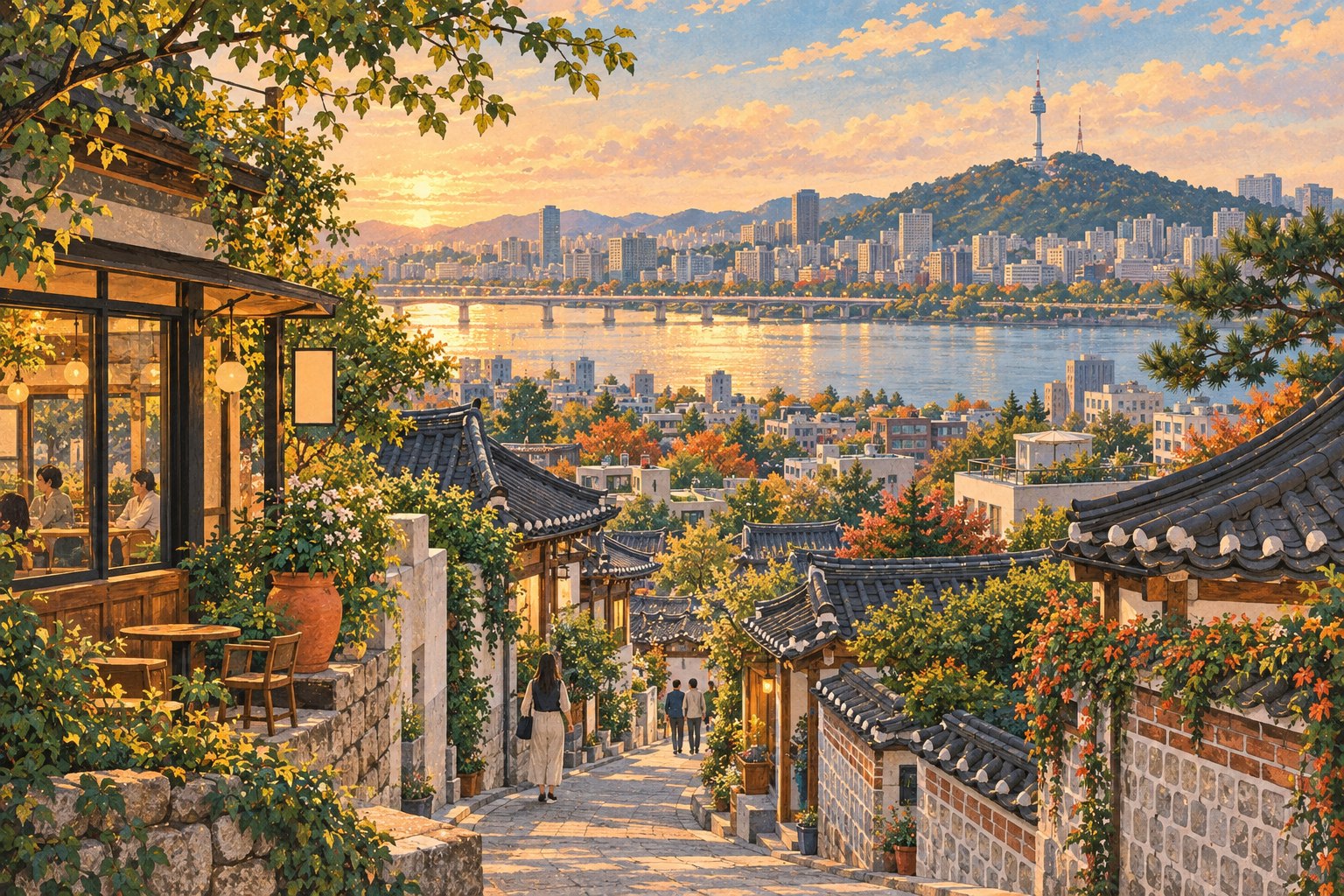
| Bukchon 북촌 | Hanok guesthouses, galleries and small lanes between the palace districts. A characterful stay for a trip built around old Seoul. | Hills, steps and traditional rooms need a closer look before booking. Sound insulation and bedding vary by hanok. Visitor access: Red-zone tourist visits are limited to 10:00–17:00. Follow posted access rules and ask your host about access to your booked stay. Official visitor notice ↗ |
| Jongno 종로 | Palace mornings, market lunches and evenings in small alleys. A well-connected base for seeing historic Seoul with plenty of places to eat along the way. | The atmosphere changes from calm Gwanghwamun hotel blocks to lively Jongno 3-ga bar lanes. Check the exact street. |
| Yeouido 여의도 | Riverside paths, department stores and business hotels with a calmer evening rhythm. A comfortable base for river walks and plans in western Seoul. | Hotels tend to cost more, and old-city sightseeing needs a ride. River events can bring crowds despite the quieter office streets. |
| Jamsil 잠실 | Seokchon Lake, Lotte World and big-city views in eastern Seoul. Especially useful when your trip revolves around this part of the city. | Central Seoul and the airport are farther away. Check the exact venue for events rather than assuming everything is near Jamsil Station. |
Bukchon is a residential neighbourhood. Keep voices low, respect private homes and follow the signs for the restricted red zone; the restriction does not describe all of Jongno. Use this table to narrow the search to two or three areas. The purpose is to identify a workable compromise, not to crown one neighbourhood as the best place for every visitor.
Airport access is only one part of the stay
An airport connection can make arrival easier, especially with luggage. But it happens only at the ends of a stay; the local trips happen every day. Balance the two. A room that helps on arrival but puts your main activities far away may not be the best overall choice.
Check whether the service you plan to use stops at your station. An express service and an all-stop train are not interchangeable simply because both travel from the airport. Look up operating times for your terminal and allow for the time between landing, entry formalities, baggage and the platform.
If arriving late, work from a realistic exit-from-the-airport time. Prepare an alternative before travelling. We do not promise that a particular flight will connect with the final train.
Compare like with like
A dorm bed per person and a private room for a party are different purchases. Compare the total for your number of guests, including the applicable charges and cancellation terms. Check bed arrangements rather than assuming that “sleeps three” means three separate beds.
In the finder, room budgets use broad planning estimates inherited from the area profiles. They are not current quotes and do not guarantee an available room. Before booking, replace the estimate with a real offer for your dates.
For a quieter stay, inspect the exact street and recent noise comments. A calm-looking photograph says little about nearby night activity, construction or sound insulation. For a traditional-style stay, ask about the facilities and access you need rather than relying only on the word “hanok.”
Three useful comparisons
Hongdae or Yeonnam?
Compare how close you want to be to lively streets with how much walking you are comfortable doing to your room. Both may appear around the same broad search area, but the exact address changes the balance. If sleep matters, inspect the street and room comments before accepting a small saving.
Myeongdong or Jongno?
Put your intended shopping, palaces, museums and evening stops on the map. Then compare the particular stations and properties on your shortlist. A first visit can work from either area; the useful question is which removes more repeated travel for your plan.
Seongsu, Gangnam or Jamsil?
A specific interest can justify a less central base for your own itinerary. Work backwards from those activities and your airport or intercity connection. For a baseball evening, check the stadium’s address: staying in Seoul does not mean every ballpark is close.
Before you book
- Can you reach the property at your likely arrival time, and are late check-in arrangements confirmed?
- Does the booking show the room, bed and bathroom arrangement you need?
- Have you checked luggage access, the final walk and any mobility requirements directly?
- Does the total price cover your party and actual dates?
- Do the recent reviews address your main concern—noise, cleanliness, access or another detail?
- Does the cancellation policy give you enough flexibility for the rest of your trip?
Never send passport or payment details to this guide. We do not book rooms or collect documents. Contact the accommodation through its verified booking or official contact route.
한국어 요약: 동네 분위기와 실제 숙소의 조건을 나눠 보세요. 공항 접근성, 주요 일정, 밤 소음, 방 구성과 총액을 비교하고 최종 이동 동선은 숙소 주소로 확인하세요.
References & limits
These references support the background facts. Our comparisons and suggested plans are editorial choices, not a live booking or availability service.
- Seoul Metropolitan Government: airport access ↗Overview of transport into Seoul. Confirm the service and time for your journey.
- Visit Seoul: accommodation directory ↗Official tourism directory. A listing is not our endorsement or a live price guarantee.
- Visit Seoul: Bukchon Hanok Village ↗Resident neighbourhood and visitor information; check current visiting restrictions.
Our matching notes explain the tool’s priorities. Korea with Chloe is independent of the Seoul Tourism Organization and its accommodation programmes.