Food / At the table
One table.
Find your next bite.
Understand the pork-belly words on the menu, compare five styles and arrive with a few useful questions in Korean.
What are you ordering?
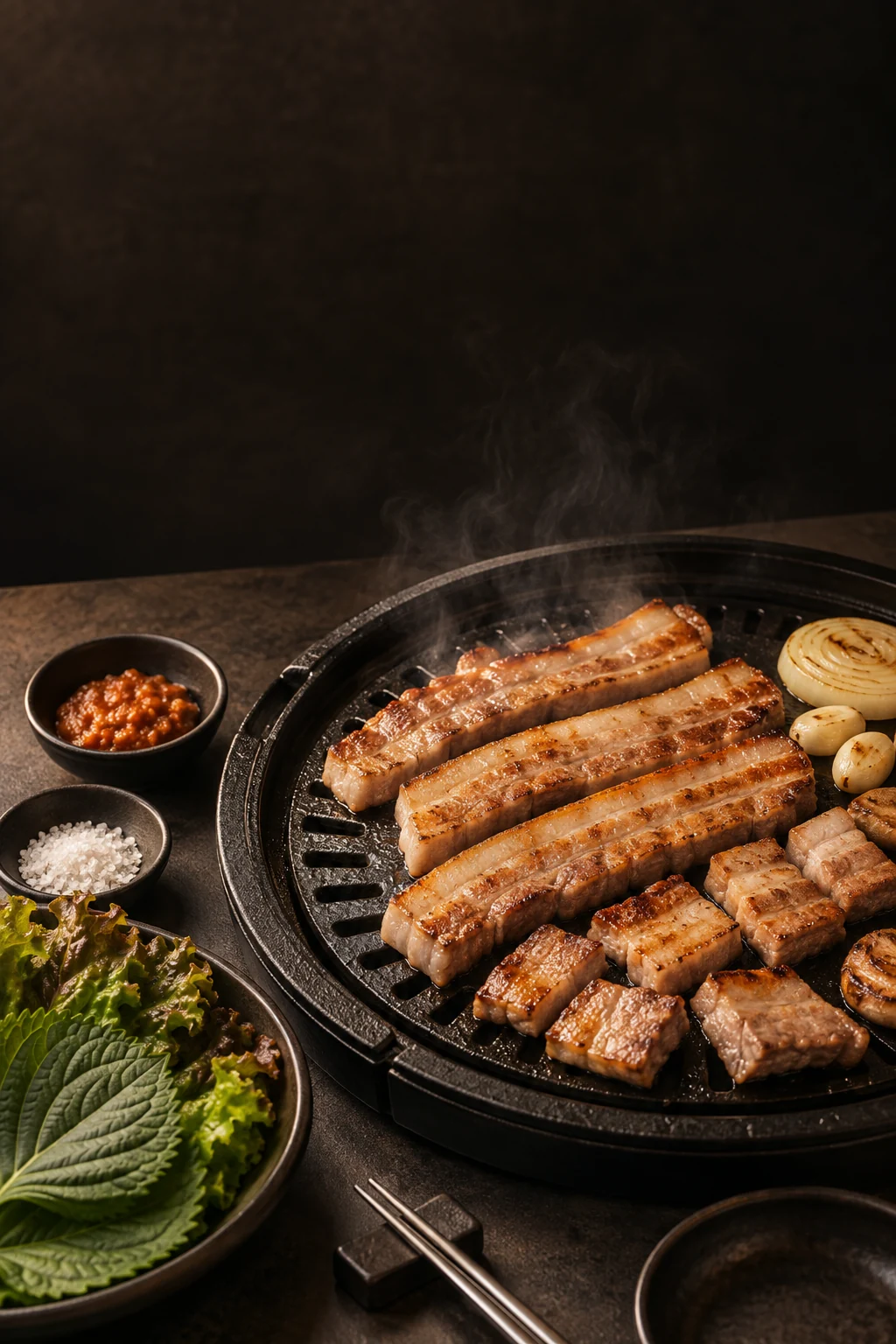
Samgyeopsal is pork belly. In a Korean barbecue meal, the cut is only one part of what you choose: thickness, whether the skin is attached, how the surface is prepared and the claimed origin may all appear in the menu description.
You may see meat eaten with leaves, garlic and dipping sauces. Build a combination you enjoy instead of worrying about performing a perfect ritual. Before ordering, establish which sides, drinks or additional dishes are included and which are separate.
For a first meal, ask the staff what they recommend for your party and whether they grill the meat or guide you through it. The service style varies; do not assume every restaurant does the cooking for you.
Five labels, different kinds of information
| Style | What the word helps describe | Ask about |
|---|---|---|
| Daepae · 대패 | Very thinly sliced pork belly. | Whether this is the thin style you want and how the restaurant serves it. |
| Tong · 통삼겹 | Pork belly served in a thick or larger whole piece. | Whether staff grill and cut it, and how it is served at this restaurant. |
| Ogyeopsal · 오겹살 | Skin-on pork belly. | Whether the skin is left on in the dish you are ordering. |
| Honeycomb · 벌집 | Surface cuts in a crosshatched pattern. | Thickness and whether the meat is marinated; scoring does not tell you either. |
| Jeju black pork · 제주 흑돼지 | An origin/type description rather than a thickness or surface treatment. | The displayed origin and the cut being sold. Do not infer it from an illustration. |
These are not five mutually exclusive anatomical cuts. A piece may be thick, skin-on and sold as Jeju black pork at the same time. Our matcher separates preferences to suggest a starting point; a restaurant’s actual menu may combine them.
If your result emphasises a feature you do not enjoy, use the explanation to ask for a different preparation. A winning score does not erase your dislike of skin or your preference for thin slices.
Read the serving, then the price
Find the unit beside the price: a menu may show a serving with a weight or a set intended for more than one person. Ask about the minimum order before sitting down if it affects your plans. Compare the same weight or set contents rather than two headline prices.
Rice, noodles, soup and drinks can be separate orders. Confirm what you want before adding several items. If the restaurant has a minimum initial meat order, ask whether different cuts can be combined to meet it.
This guide does not publish a universal price or portion rule because restaurants differ. The most useful check is the menu in front of you, confirmed with the staff.
Small questions that help
| Korean | Meaning |
|---|---|
| 1인분은 몇 그램인가요? | How many grams are in one serving? |
| 최소 몇 인분부터 주문할 수 있나요? | What is the minimum number of servings we can order? |
| 직접 구워 주시나요? | Will you grill it for us? |
| 껍질이 붙어 있나요? | Does it have the skin on? |
| 양념하지 않은 고기인가요? | Is the meat unseasoned? |
| 밥은 따로 주문하나요? | Do we order rice separately? |
These phrases are conversation starters, not a guarantee that a request can be accommodated. Point to the particular menu item so both you and the staff are discussing the same thing.
Make the meal comfortable
Let staff explain the equipment, handling and service. Keep personal items away from hot surfaces and ask for help when you are unsure. This is a menu guide, not a timed cooking or food-safety instruction.
Tell the restaurant about dietary restrictions before ordering. Pork, sauces and side dishes may make a venue unsuitable for your needs; an unseasoned cut does not establish the ingredients or preparation of the whole meal. Do not rely on the matcher to clear an allergy or dietary requirement.
If you are dining alone, travelling with children or need specific seating, check the restaurant’s arrangements directly. Photos of a generous spread do not establish what your order includes.
What your match means
Six questions compare the features you enjoy. The tool explains conflicts as well as matches and offers phrases for expressing your preference. It does not rank restaurants, authenticate origin, assess health effects or identify a cut from a photograph.
For a simple first choice, pick one feature that matters most—thinness, thickness, skin or preparation—and ask the restaurant to show you the closest menu item. Then let the actual dish, price and service decide.
한국어 요약: 두께·껍질·칼집·원산지 표시는 서로 다른 기준이라 한 고기에 겹칠 수 있습니다. 메뉴의 중량과 최소 주문량, 직원이 구워 주는지 확인하세요. 추천 결과는 취향 안내이며 실제 품종·원산지나 식이 적합성을 보증하지 않습니다.
Food references
Food definitions are combined with our own ordering explanations. We have not tested a meal or authenticated a supplier for this guide. Menus, serving weights, preparation and prices belong to each restaurant.
- VISITKOREA: grilled pork belly ↗Background on samgyeopsal and common accompaniments.
- VISITKOREA: thin-sliced pork belly ↗Reference for daepae samgyeopsal.
- VISITKOREA: Heukdonga Samseong ↗An example of black pork and skin-on pork belly labels used together; not a restaurant recommendation.